
bennett legal case studyBennett Legal: Scaling Consumer Arbitration Intake
How a Dallas litigation firm added consumer arbitration for solar fraud using programmatic SEO, a multi-channel intake pipeline, and deterministic CRM data.
Bennett Legal is a litigation firm in Dallas, Texas. When managing attorney Charles Bennett decided to expand into solar panel fraud, a high-volume, fee-shifting subset of consumer arbitration intake, he hit an operational wall. Solar claims demand programmatic precision: statutory deadlines, predatory lending disclosures, and rigid arbitration clauses.
A standard website with a generic contact box cannot process claims at this volume.
We rebuilt Bennett Legal's web presence from the server up. We replaced an isolated WordPress instance with a programmatic Git-backed publication system, paired it with Claude Cowork, and engineered a multi-channel qualification funnel that feeds structured data straight into the firm's CRM.
Replacing WordPress with Git and Claude Cowork
Bennett Legal originally managed content through WordPress. The administrative overhead slowed publishing: drafts sat in isolated database fields, formatting broke between previews, and handing drafts between the managing attorney and outside copywriters required endless back-and-forth emails.
We migrated the entire site to a programmatic static framework backed directly by GitHub. Every article lives as a Markdown file in a repository folder.
┌────────────────────────────────────────────────────────────────────────┐
│                   PROGRAMMATIC PUBLISHING WORKFLOW                     │
└────────────────────────────────────────────────────────────────────────┘
 [ Charles Bennett ]  ──> Dictates core case angle & statutory focus
         │
         ▼
  [ Claude Cowork ]   ──> Generates Markdown draft & metadata schema
         │
         ▼
 [ Git Repository ]   ──> Single commit updates site state & audit logs
         │
         ▼
  [ React / Solid ]   ──> Sub-second page delivery with zero database lag
This architecture changed how the firm publishes:
- Direct Authoring: Charles Bennett and his copywriter write directly inside Claude. When a post meets firm standards, the model commits clean Markdown straight to the GitHub repository.
- Instant Reviews: To assign an article or request revisions, the managing attorney sends a single repository link over Slack.
- Zero Database Overhead: Because the front end renders Markdown cleanly at build time, the firm eliminated CMS vulnerabilities, slow database queries, and clunky administrative panels.
The search footprint grew rapidly. Organic search models and conversational AI engines, including ChatGPT and Google Search, indexed the firm's domain as an authoritative source for solar arbitration in Texas, driving a surge in qualified claimant inquiries.
The Intake Funnel: From Open Text to Structured Milestones
High organic traffic creates a secondary problem: intake congestion.
Bennett Legal's original contact form consisted of basic name fields and an open-ended text box. Claimants wrote sprawling paragraphs. Paralegals spent twenty minutes per submission extracting basic facts, checking loan amounts, and determining whether the lender was even a target defendant.
We sat down with Charles Bennett to reverse-engineer his qualification criteria. We replaced the open text box with a three-stage, milestone-driven qualification engine.
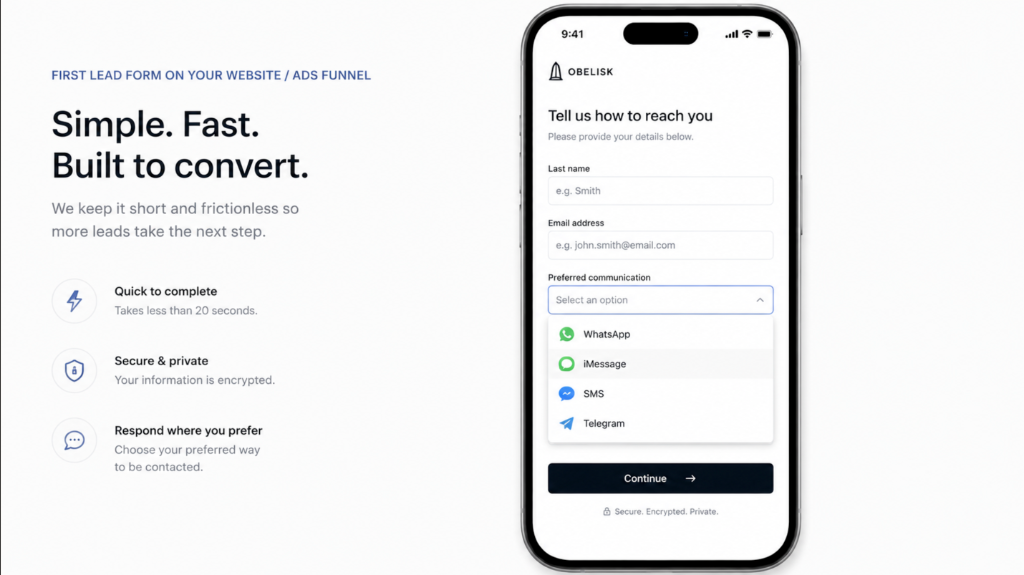
Milestone 1: Contact Capture and Channel Preference
Long forms intimidate users. Most claimants abandon them when asked for sensitive financial paperwork on the first screen.
Bennett Legal's first milestone asks only for essential identity details: name, email, and preferred communication channel. The moment the user clicks Continue, the backend logs the record at Stage 1: New.
If a claimant closes the browser ten seconds later, their file does not disappear. The intake staff retains their contact details and can follow up immediately.
┌──────────────────────────────────────────────────────────┐
│                 WORK WITH OBE: TWO PATHS                 │
└──────────────────────────────────────────────────────────┘

Most legal software locks your data into a proprietary silo and rents it back
to you on an endless monthly subscription. We offer a cleaner approach:

[ Option 1: Buy the System Outright - $6,999 (One-Time) ]
• A fully rebuilt intake form tailored to your firm's specific case types.
• Direct website integration handled by our team.
• OBE CRM, Client Portal, and Expert Portal self-hosted on your own server.
• Zero monthly SaaS fees. You own the code forever.
• Need custom changes later? Hire our engineers on demand.

[ Option 2: The Managed Platform - $1,700 / month ]
• Continuous updates and new features as we ship them.
• Deep integrations with our upcoming legal case management platform.
• Ongoing support and maintenance.
👉 Book a 30-Minute Architecture Call with Tim Ottowitz
Review your firm's current case types and see how structured intake works in practice.
3. Two-Stage Intake and Omnichannel Recovery
The core architectural shift was replacing the traditional 30-question web form with a two-stage collection model:
- Stage 1 (Lead Capture): A short questionnaire collecting core contact info and basic qualification criteria.
- Stage 2 (Case Structuring): A deeper follow-up workflow gathering specific transaction records, finance paperwork, and detailed dispute timelines.
If a prospective client dropped off during Stage 2, traditional systems would lose the lead entirely.
By capturing the claimant's preferred channel on screen one, whether WhatsApp, iMessage, SMS, or Telegram, OBE automates abandoned-session recovery where the client actually reads:
- Persistent State Links: Reminders include a single, authenticated link that reopens the exact field where the user stopped. No answers are lost.
- Automated Follow-Up Sequences: The system sends three polite reminders over two weeks before archiving an inactive lead.
- Staff Escalation: Intake specialists review filterable queues to call promising drop-offs directly.
Milestone 2: The Primary Target Filter
Bennett Legal focuses its arbitration practice against specific non-bank financial institutions, particularly GoodLeap and Sunlight Financial.
Milestone 2 asks a single qualifying question: Who financed your solar system?
If the claimant financed through an unsupported lender, the system diverts the file without burning paralegal time. If the lender matches target criteria, the lead advances to statutory screening.
Milestone 3: Statutory Claims and Damages Breakdown
The final milestone captures the nine variables required to assess liability, statutory fee-shifting, and arbitration venue:
- Total Financed Amount (Including Interest): Verifies the claim meets the firm's minimum economic threshold and reveals predatory dealer markups.
- Contract Execution Date: Checks the Statute of Limitations (SOL) for fraud, breach of contract, and Truth in Lending Act (TILA) claims, as well as 3-day statutory rescission rights.
- Solar Contract Upload (Optional): Evaluates mandatory arbitration clauses, class action waivers, DocuSign forgery claims, and specific lender identities.
- Claimant Age at Signing: Identifies elder financial abuse claims under Texas, California, or Florida statutes, which unlock treble damages and statutory attorney fees.
- Household Size at Signing: Establishes the Federal Poverty Level (FPL) baseline at loan origination.
- Household Income at Signing (Optional): Uncovers unconscionable debt-to-income ratios and falsified credit applications submitted by sales representatives.
- Current Household Size: Updates economic status to determine active hardship.
- Current Household Income (Optional): Confirms qualification for subsidized or pro bono arbitration funds (typically under 300% of Federal Poverty Guidelines).
- Estimated Home Market Value (Optional): Evaluates foreclosure exposure created by UCC-1 fixture filings or PACE tax assessment super-liens.
What Happens When Data Enters the CRM
The intake form is only the front door. The real operational advantage lives in how the CRM processes submissions.
Every submission enters the pipeline at Stage 1: New. If a claimant drops off after Milestone 1, intake staff review their record in an exception queue and schedule manual follow-up.
When a claimant completes all three milestones, the record advances automatically to Stage 2: Intake.
Stage 2 is not a contact card. It is a full case-fact extraction environment. When the claimant uploads their installation contract, loan agreement, or text transcripts, OBE's clean intake data pipeline parses the files into structured JSON. The platform's Entity Engine resolves factual contradictions between documents and spoken claims using strict truth hierarchies, prioritizing signed agreements over informal estimates.
The result is an attorney-ready Factframe. Before Charles Bennett opens a file, the essential facts, statutory deadlines, and loan terms sit verified in a clean dashboard.
If your firm still relies on open-ended contact forms and manual document chasing, you are losing viable cases to operational friction. Read our deep dive on how OBE turns legal intake into a clean data pipeline or see how we scaled Bennett Legal from zero to 642 qualified intakes in six months.
Ready to automate your firm's case intake?
👉 Schedule a Free 30-Minute Consultation with Tim Ottowitz
We will inspect your current case types, audit your intake bottlenecks, and map a clean pipeline tailored to your firm.
Bring one matter type